
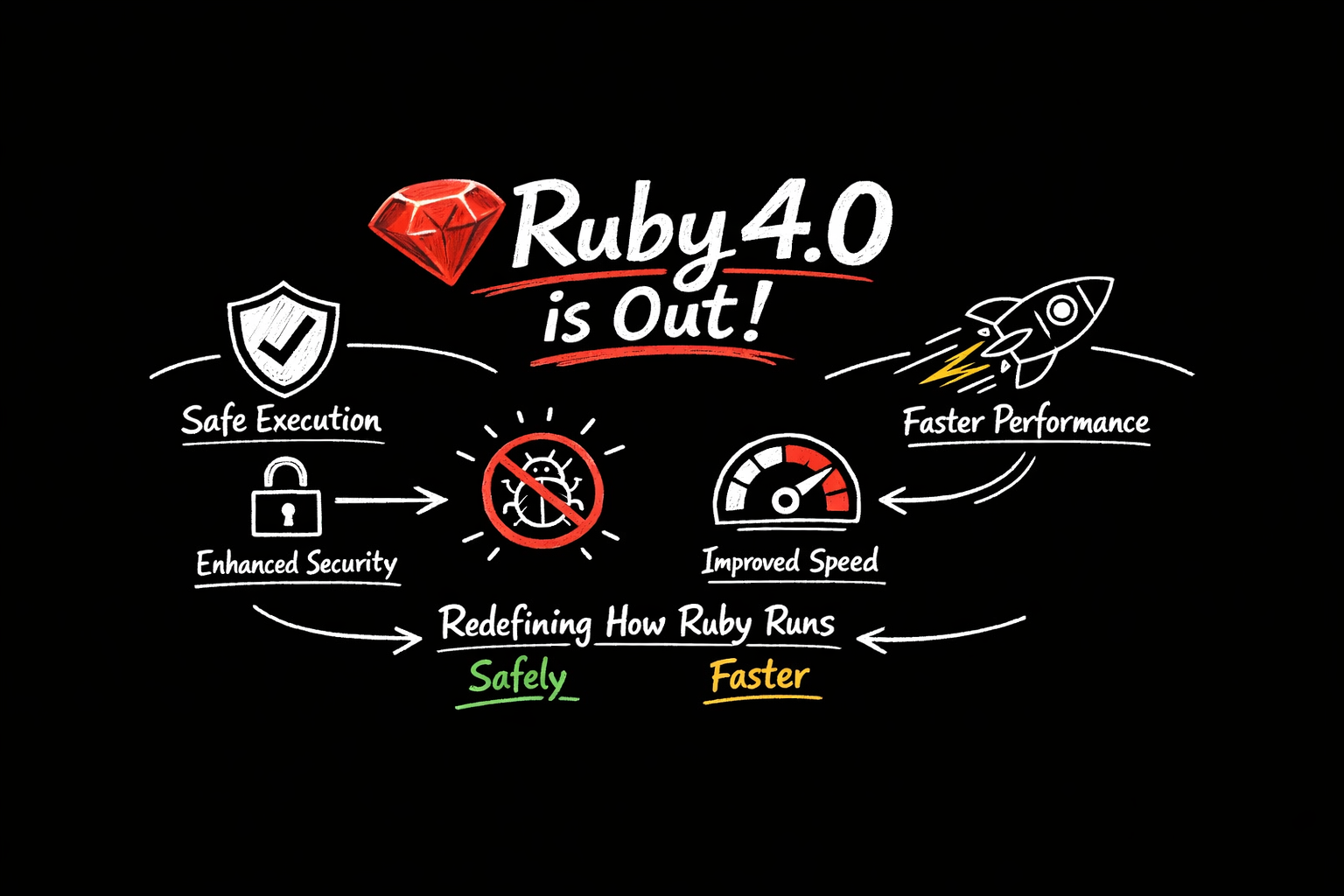
Ruby 4.0 has been released.
At first glance, it looks like a typical major update: performance gains, concurrency tweaks, and standard library cleanups.
But two changes stand out.
They point to a deeper shift in how Ruby wants you to run code safely and push performance further in the long term.
Table of Contents
Ruby’s Real Problem Wasn’t Features — It Was Trust
If you’ve worked with Ruby long enough, you’ve probably run into this situation:
You want to run tests that rely on heavy monkey patching.
Or you want to compare two dependency versions side by side.
Or you want to deploy two versions of the same app in parallel.
And suddenly, everything feels fragile.
Global state leaks.
See also: Mastering the Linux Command Line — Your Complete Free Training Guide
Classes collide.
One experiment breaks another.
Ruby has always favored flexibility over isolation. That tradeoff powered its ecosystem — but it also made certain workflows unnecessarily risky.
Ruby 4.0 is the first release that seriously addresses this tension.
What Actually Changed (Before We Talk About How)
Two experimental features define Ruby 4.0’s direction:
Ruby Box, a new isolation mechanism inside a single Ruby process.
And ZJIT, a new just-in-time compiler designed to raise Ruby’s long-term performance ceiling.
Everything else in the release — concurrency refinements, language tweaks, library reorganizations — supports that same theme: clearer boundaries, fewer surprises, and better performance under pressure.
Ruby Box: Isolation Without Forking Your World
Here’s the surprising behavior Ruby 4.0 introduces.
You can now run Ruby code inside a “box” that isolates:
- Class and module definitions
- Global variables
- Monkey patches
- Even loaded libraries
All inside the same process.
Enable it with a single switch:
RUBY_BOX=1
From the outside, this looks strange.
Why isolate code inside a language that has always shared everything?
The answer is simple: Ruby no longer assumes all code in a process deserves the same level of trust.
Ruby Box exists because modern Ruby workflows demand experimentation, parallel evaluation, and safety — without paying the cost of separate processes.
That’s why Ruby Box fits scenarios like:
Running test suites that rely on invasive monkey patches.
Trying two versions of a dependency at the same time.
Deploying blue-green versions of the same app side by side.
This isn’t sandboxing for security.
It’s isolation for predictability.
ZJIT: A New Compiler With a Longer Horizon
Ruby 4.0 also introduces ZJIT, a brand-new experimental JIT compiler.
This matters less for what it does today — and more for what it enables next.
ZJIT replaces YJIT as Ruby’s long-term JIT strategy.
It compiles methods using larger units and an SSA-based intermediate representation, making it easier to reason about and extend.
Right now:
- ZJIT already beats the interpreter
- It’s still slower than YJIT
- It’s not recommended for production
That’s intentional.
The Ruby core team isn’t chasing short-term benchmarks here.
They’re building a compiler that external contributors can realistically work on — and that can scale performance improvements over multiple releases.
If this sounds familiar, it should.
This is the same playbook used by many modern language runtimes: invest early in infrastructure, then reap gains steadily.
Concurrency: Less Locking, Clearer Communication
Ruby’s Ractor model also gets meaningful refinement.
A new Ractor::Port class replaces older communication APIs like Ractor.yield and Ractor#take, which are now removed.
The goal is clarity and robustness, not novelty.
Under the hood, Ruby 4.0 also reduces global lock contention, minimizes shared internal state, and improves CPU cache behavior.
None of this is flashy.
All of it matters if you care about real parallel performance instead of theoretical concurrency.
Language and Library Changes That Remove Friction
Ruby 4.0 includes many smaller changes that are easy to miss but hard to argue against:
Multiline logical operators now read more naturally.
Error messages for argument mismatches are clearer and more contextual.
Splat behavior around nil is more consistent.
Several core and standard library components were cleaned up or promoted:
Set and Pathname are now core classes.
Unicode support moves to version 17.0, including new emoji.
Long-deprecated APIs across IO, Thread, Fiber, Socket, and Kernel are finally gone.
This isn’t about adding power.
It’s about removing ambiguity.
Performance: Fewer Surprises in Hot Paths
Performance improvements in Ruby 4.0 are broad rather than dramatic.
Object creation is faster, especially with keyword arguments.
Garbage collection is more efficient across multiple dimensions.
Instance variable access is cheaper.
Locking has been reduced in many hot paths.
These are the kinds of changes you don’t notice immediately — until you deploy at scale.
Compatibility: What You Actually Need to Watch
Ruby 4.0 does remove things.
Deprecated APIs are gone.
Older Ractor methods no longer exist.
Some C APIs have been adjusted for safety.
Windows builds now require Visual Studio 2015 or newer.
None of this is surprising.
But it does mean upgrading blindly isn’t a great idea.
What This Release Really Means
Ruby 4.0 isn’t a “killer feature” release.
It’s a course correction.
Ruby is slowly shifting from a language that assumes everything shares everything, to one that acknowledges isolation, boundaries, and long-term runtime evolution.
Ruby Box questions the idea that global state is inevitable.
ZJIT questions the idea that performance gains must be incremental hacks.
If you’re a Ruby developer, the takeaway isn’t “turn this on in production.”
It’s this:
Ruby is preparing itself for a future where safety, performance, and experimentation no longer fight each other.
And Ruby 4.0 is the first real step in that direction.