Software management isn’t the most exciting part of an operating system — until it breaks.
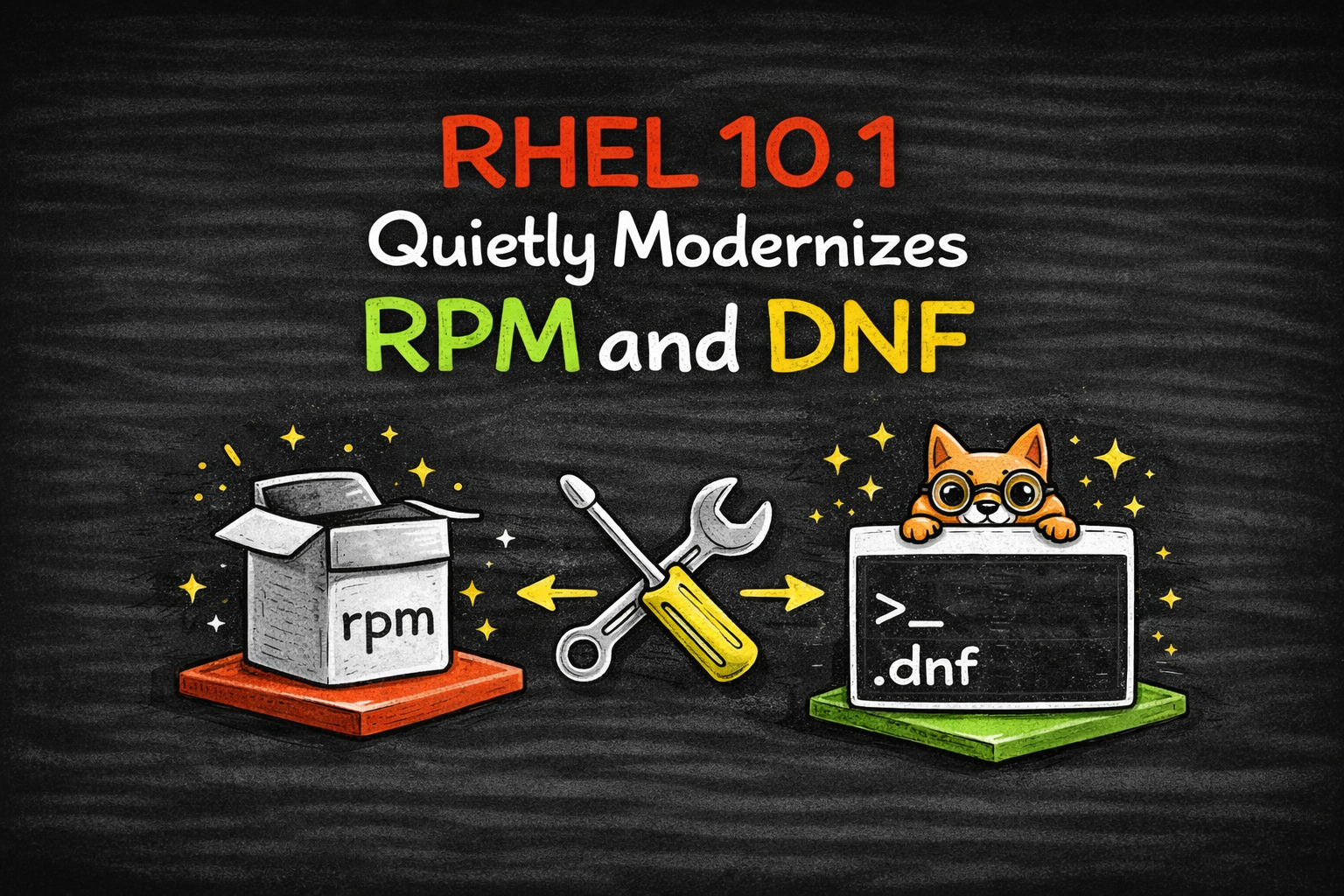
In Red Hat Enterprise Linux 10.1, Red Hat has rolled out a set of updates to RPM and DNF, the two tools responsible for installing, updating, and verifying software on RHEL systems. On the surface, the changes look incremental. Under the hood, they point to a bigger shift around security, cryptography, and long-term maintainability.
Table of Contents
Why RPM and DNF still matter
RPM and DNF sit at the core of every RHEL system.
RPM defines how software is packaged, signed, and verified. DNF is the layer administrators interact with — searching repositories, installing updates, and keeping systems current. If these tools aren’t reliable or secure, everything built on top of them becomes fragile.
That’s why Red Hat continues to evolve them, even when the changes aren’t flashy.
RPM signatures, updated for what comes next
One of the most notable updates in RHEL 10.1 is a major improvement to RPM’s signature system.
Package signatures are what ensure software comes from a trusted source and hasn’t been altered since it was built. As cryptographic standards evolve — and with post-quantum threats on the horizon — relying on a single algorithm is no longer a safe long-term strategy.
RHEL 10.1 introduces RPMv6 signatures, which bring two important changes:
- Support for multiple signatures per package
- Adoption of the OpenPGP v6 standard (RFC 9580)
This allows packages to be signed using multiple cryptographic algorithms at once, including newer options such as ML-DSA, which is designed with post-quantum security in mind.
The practical benefit is flexibility. If a signing algorithm is weakened or deprecated in the future, it can be disabled via policy — without breaking package verification or disrupting updates. The system keeps working, just with a different trusted signature.
See also: Mastering the Linux Command Line — Your Complete Free Training Guide
For enterprise environments with long lifecycles, that’s a big deal.
More control, less risk
Beyond new algorithms, RPM now offers more granular control over signature handling. Administrators can better define which formats and algorithms are acceptable, aligning package verification with organizational security policies.
Instead of scrambling during a cryptographic transition, RHEL systems can adapt gradually — and predictably.
Modularity is on its way out
RHEL 10.1 also continues a quieter cleanup effort: phasing out modularity.
Modularity was originally introduced to allow multiple versions of the same application to coexist. In practice, it added complexity and confusion for many users. Red Hat has since shifted toward simpler, versioned RPMs, and modularity is now officially deprecated.
DNF in RHEL 10.1 emits deprecation warnings to help teams identify remaining modular dependencies and prepare for modularity’s eventual removal. It’s a nudge to clean things up before the safety net disappears.
A small release, but a meaningful one
None of these changes dramatically alter how you run dnf install or rpm -q. That’s the point.
RHEL 10.1 focuses on strengthening the foundation: better cryptographic agility, clearer packaging models, and more predictable system management. For administrators responsible for long-lived, security-sensitive systems, these improvements reduce risk without increasing operational complexity.
In enterprise Linux, that balance matters.
If you want the full technical details, Red Hat’s documentation goes deeper. But the takeaway is simple: RHEL 10.1 modernizes software management where it counts — quietly, carefully, and with the future in mind.