Over the past few years, something interesting has been happening inside Microsoft.
Quietly. Gradually. But very deliberately.
Rust keeps showing up.
In Windows internals.
In security talks.
In job listings that sound… ambitious.
Then, in late 2025, one statement caught everyone’s attention.
“My goal is to eliminate every line of C and C++ from Microsoft by 2030.”
That wasn’t a random tweet.
It came from Galen Hunt, a distinguished engineer at Microsoft.
See also: Mastering the Linux Command Line — Your Complete Free Training Guide
And yes — he meant all of it.
Let’s talk about what’s actually going on here.
Table of Contents
First, Let’s Be Clear: This Isn’t a Rewrite Button
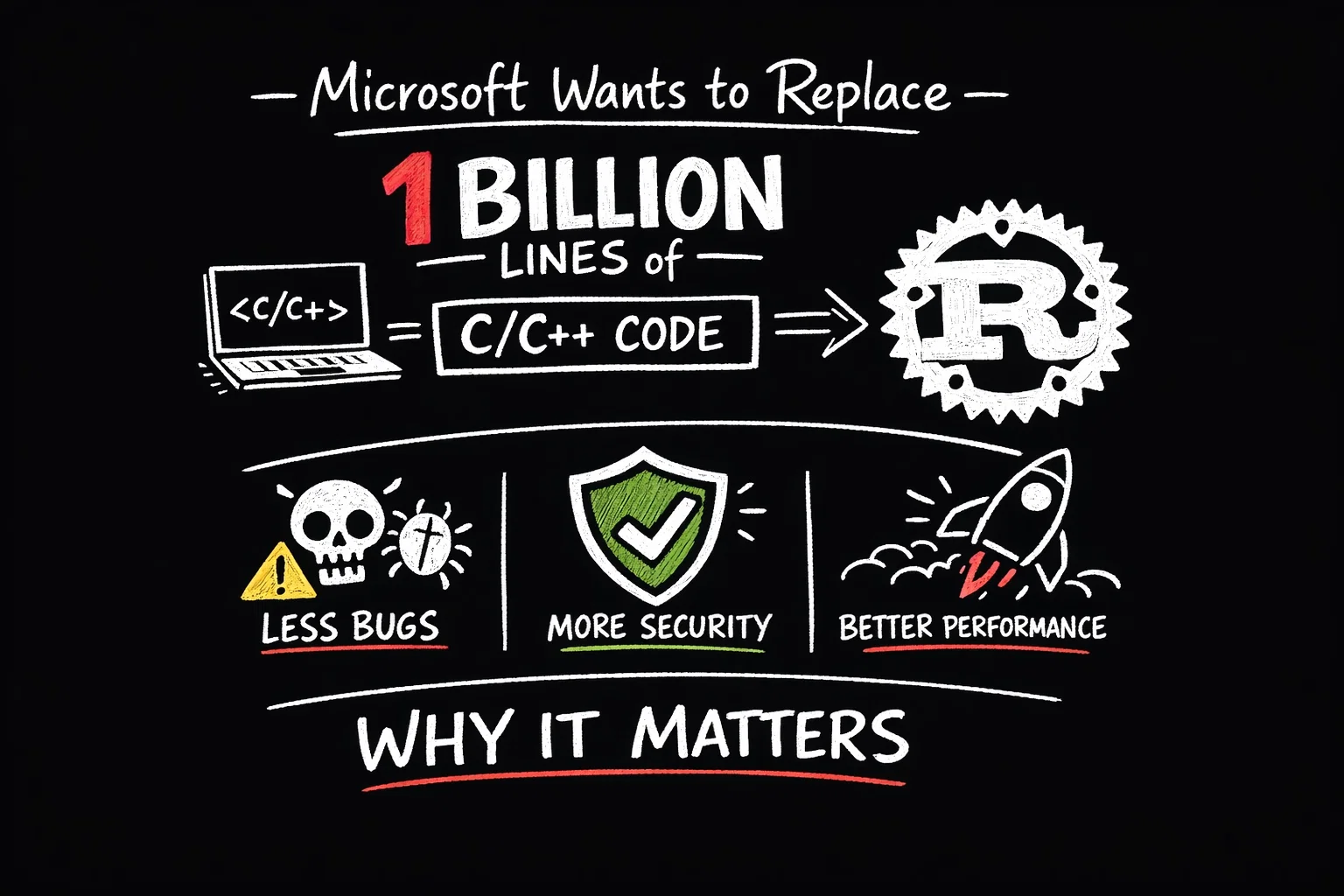
When people hear “replace a billion lines of C/C++”, the first reaction is usually disbelief.
A billion lines?
With Rust?
In a few years?
Sounds unrealistic. Or reckless.
But that’s not what Microsoft is doing.
They’re not asking thousands of engineers to manually rewrite everything line by line.
They’re building infrastructure — and using AI — to make large-scale translation possible.
This isn’t a weekend refactor.
It’s an industrial operation.
Why Rust — And Not C#?
This question came up immediately.
Why Rust?
Why not C#, Microsoft’s own flagship language?
Hunt’s answer was blunt:
- C# is memory-safe, but not concurrency-safe
- Rust gives memory safety and concurrency safety
- Rust delivers native performance, without a garbage collector
And performance still matters.
Especially when you’re talking about kernels, drivers, databases, and core infrastructure.
At Microsoft alone, Hunt estimates there are around one billion lines of C and C++ code that could be rewritten.
Across the entire industry? Possibly 20–40 billion lines.
That’s the scale of the problem they’re aiming at.
So… How Do You Rewrite Code at That Scale?
This is where things get interesting.
Microsoft’s plan isn’t just “use AI and hope for the best.”
They’ve built a code-processing platform that understands massive codebases as graphs — not just files.
Here’s the internal goal Hunt described:
“One engineer. One month. One million lines of code.”
That would have sounded absurd a few years ago.
Now, Microsoft claims it’s achievable.
The idea is simple in theory:
- Algorithms map and understand large codebases
- AI agents, guided by those algorithms, perform transformations
- Changes happen consistently, at scale
And this infrastructure isn’t hypothetical.
It’s already being used for large-scale code understanding today.
This Isn’t New — Microsoft Has Been Moving This Way for Years
If this feels sudden, it’s not.
Back in 2022, Azure CTO Mark Russinovich said Microsoft should stop starting new C/C++ projects when a non-GC language is needed — and use Rust instead.
At RustConf 2025, he went even further.
He described C and C++ as languages that can look correct…
and still fail catastrophically.
Worse, they can fail silently — in ways attackers love.
He compared parts of the Windows kernel to:
“An underground oil repository that leaks a few drops at a time. Constantly.”
So Microsoft started doing something very deliberate.
They didn’t rewrite everything.
They rewrote the dangerous parts first.
Rust Is Already Running Inside Your Windows Kernel
This isn’t theoretical.
If you look inside a modern Windows System32 directory, you’ll find:
win32kbase_rs.sys
That _rs isn’t decorative.
That’s Rust.
And here’s the most important detail:
When a bug was found in the Rust version, the system crashed safely.
No privilege escalation.
No exploit path.
In the old C++ version, that same class of bug could have meant a security vulnerability.
From Microsoft’s perspective?
That crash was a success.
What Microsoft Is Really Trying to Fix
This isn’t about language trends.
Or hype.
Or rewriting code for fun.
It’s about technical debt at scale.
Decades of systems code.
Written under different assumptions.
In languages that give you enough rope to hang yourself.
Microsoft’s long-term goal is simple to state, and very hard to execute:
Make entire classes of security bugs impossible by default.
Rust doesn’t make bugs disappear.
But it changes how software fails.
And that difference matters.
Final Thoughts
So no — Microsoft isn’t “abandoning” C and C++ overnight.
But they are clearly planning a future where:
- New systems code is written in Rust
- Old code is gradually translated
- Crashes are preferable to exploits
- Safety is enforced by the compiler, not by hope
A billion lines sounds extreme.
But given the cost of security failures at Microsoft’s scale?
It might actually be the conservative option.
And this time, the shift isn’t subtle.
It’s intentional.
It’s funded.
And it’s already happening.
🦀