If you’re in IT operations, you know the pain: Your team leans on Red Hat’s Ansible Automation Platform to streamline critical workflows—until a shaky database brings everything to a standstill.
Ansible excels at standardizing tasks, scaling across cloud and on-prem environments, and prioritizing security—but even the best automation tool is only as strong as its database foundation.
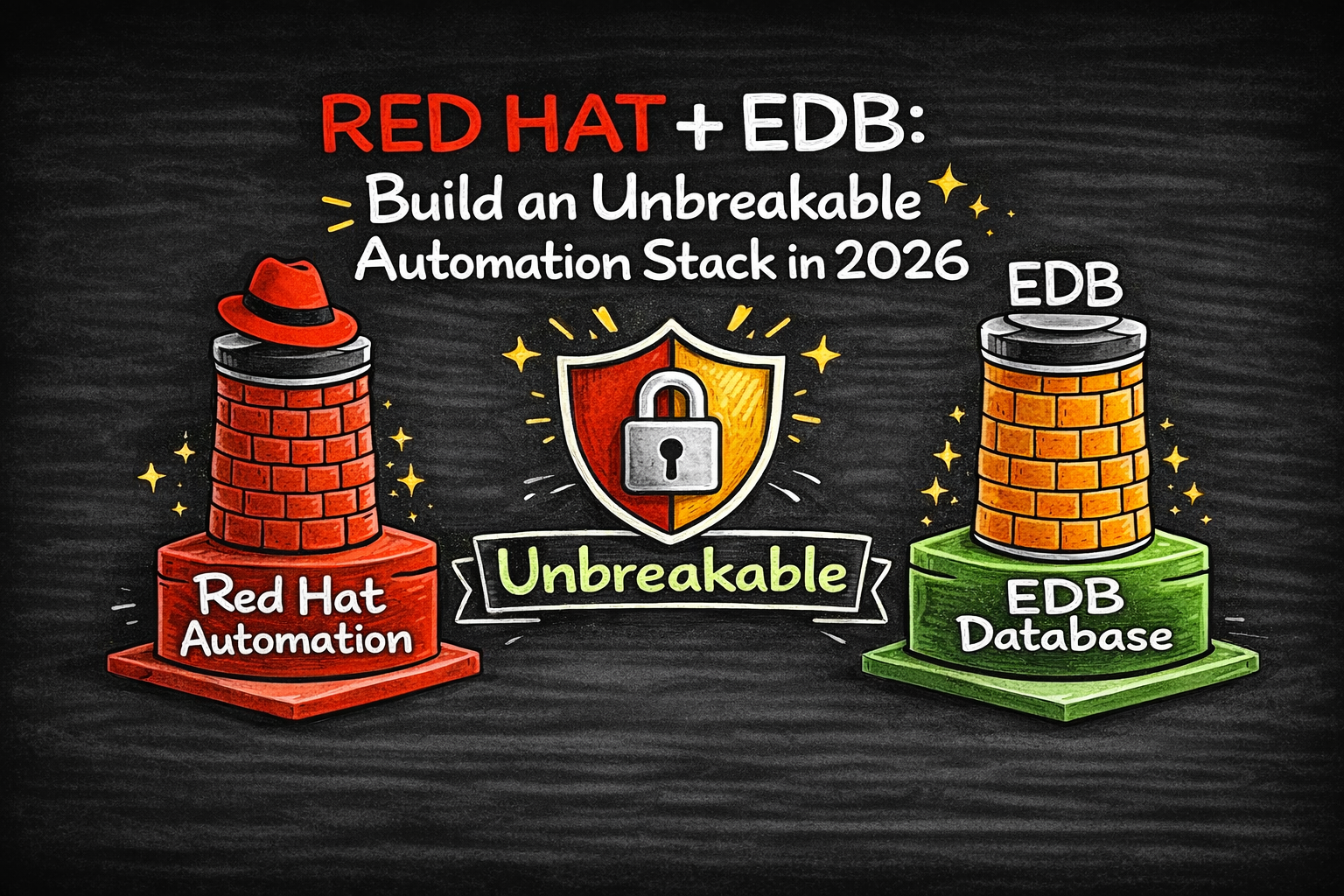
That’s why Red Hat’s new strategic partnership with EDB, a global PostgreSQL leader, is a game-changer. Together, they’re building an automation stack that’s not just efficient, but resilient—eliminating the downtime risks that plague IT teams. Here’s why this collaboration matters.
Table of Contents
The Problem: Databases Are Automation’s Achilles’ Heel
Ansible can’t run without a database. Every workflow, policy, and automated task relies on that backend to store data and execute processes.
A single database outage—from hardware failure, cyberattacks, or human error—can grind your automation to a halt. For enterprises where downtime costs thousands per minute, this isn’t just an annoyance—it’s a business risk.
Basic database uptime isn’t enough. Teams need continuous availability, automatic recovery, and ironclad data protection. That’s where EDB’s 20 years of PostgreSQL expertise comes in: it’s the reliability boost Ansible needed to turn “good automation” into “unbreakable automation.”
The Solution: Ansible + EDB Postgres AI = Resilience by Design
The partnership’s core is simple: a turnkey integration of Ansible Automation Platform and EDB’s Postgres AI database clusters, built for production use. No more cobbling together tools—just a seamless stack focused on uptime. Here’s the key value:
- Automated Deployment (No Manual Headaches) Set up a full enterprise-grade database cluster—OS, PostgreSQL, failover tools included—using Ansible’s native tools. It follows EDB’s validated best practices out of the box, cutting setup time from days to hours and eliminating configuration errors. IT teams get to focus on scaling automation, not managing infrastructure.
- Automatic Failover (Zero Downtime, Zero Intervention) The stack uses an active-passive replication model: a primary node handles tasks, while standbys mirror data in real time. EDB Postgres AI monitors 24/7; if the primary node crashes, a standby instantly takes over—no human input required. It’s a silent safety net that keeps automation running without a blip.
- Disaster Recovery (Minimize Data Loss) Beyond uptime, the solution includes full/incremental backups and point-in-time recovery (PITR). If disaster strikes, you can restore your database to a specific moment, slashing data loss and getting workflows back on track fast. For regulated industries like finance and healthcare, this is non-negotiable.
Why This Matters for Your Team
- No vendor finger-pointing: Red Hat and EDB offer joint support. One point of contact for issues spanning the automation platform and database—no more bouncing between teams.
- Flexible choices: Pick open-source PostgreSQL or EDB’s Postgres AI, based on your workloads and budget. No lock-in, just the right tool for the job.
- Scalable growth: The stack grows with your automation needs, whether you’re adding 10 workflows or 1,000—no performance tradeoffs.
The Future of Resilient Automation
This isn’t a one-off fix. Red Hat and EDB plan to refine the stack with better observability, simplified multi-cloud deployments, and AI-driven database management. It’s an investment that evolves with your business, not a short-term band-aid.
At the end of the day, automation should make your life easier—not stress you out about database outages. Red Hat and EDB’s partnership delivers that peace of mind, building an automation stack that’s efficient, secure, and built to last.
What’s your biggest automation pain point? Have database outages derailed your workflows? Drop a comment and let’s talk.
See also: Mastering the Linux Command Line — Your Complete Free Training Guide
Learn more: Check out Red Hat’s official announcement or EDB’s Postgres AI docs.