
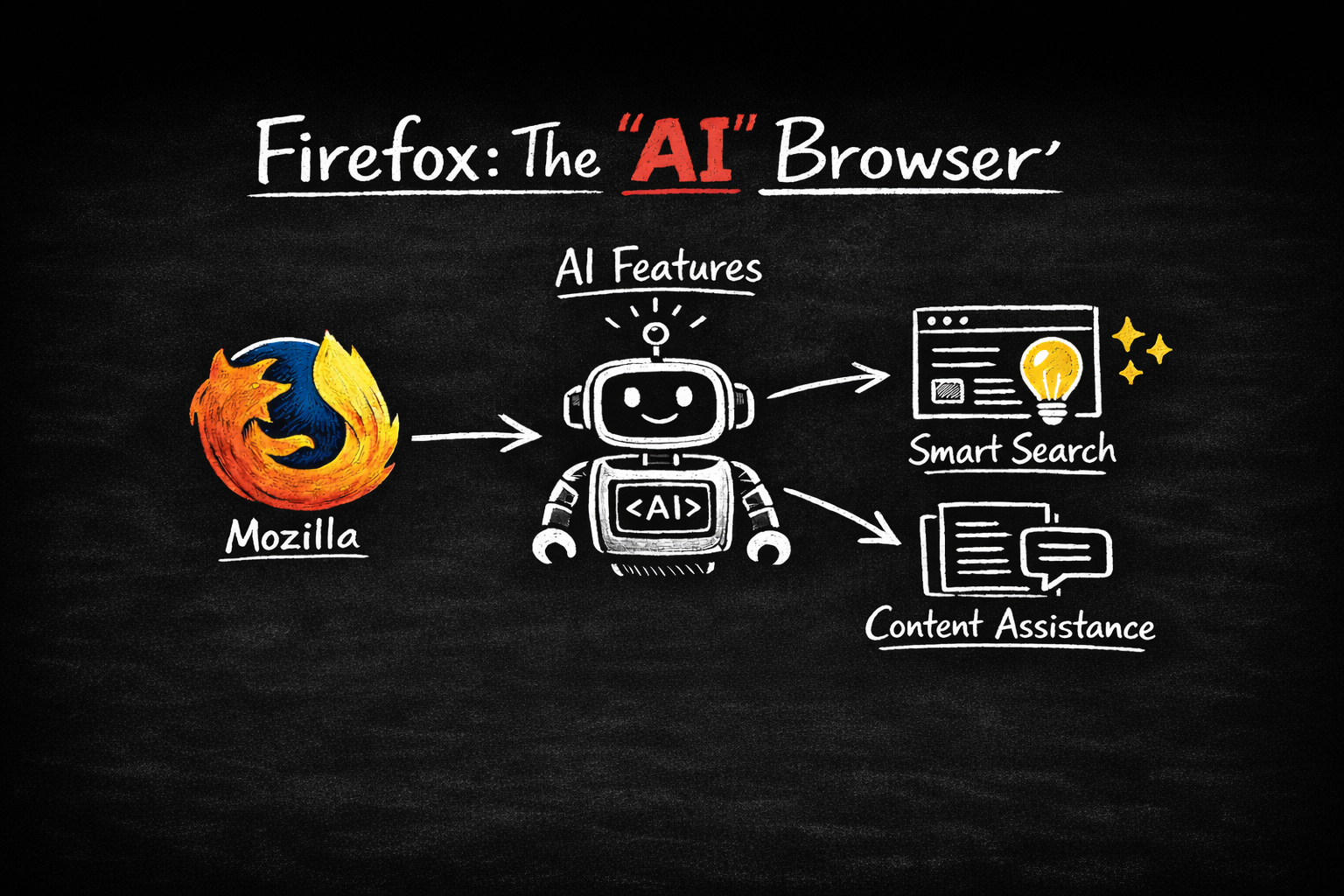
Mozilla has a new CEO, and one of his first public messages is unambiguous: Firefox is becoming an AI browser.
Anthony Enzor-DeMeo says Firefox will remain Mozilla’s “anchor”, but it will also evolve into a modern, AI-powered platform — not simply to ship new features, but to unlock additional revenue streams at a time when Firefox’s market share continues to shrink.
This isn’t just a product announcement.
It’s a shift in what Firefox is supposed to be — and who it ultimately serves.
Table of Contents
The Problem Mozilla Is Actually Trying to Solve
Mozilla’s situation isn’t hard to understand.
The majority of its revenue still comes from its search deal with Google, while Firefox’s share of the browser market keeps declining year after year. At the same time, AI chatbots are increasingly replacing traditional search as the starting point for information discovery.
From Mozilla’s perspective, this combination is dangerous.
If AI interfaces become the primary way people navigate information, a browser that doesn’t meaningfully participate in that shift risks becoming invisible.
Seen through that lens, the move toward an “AI browser” isn’t about novelty or trend-chasing. It’s about relevance — and, ultimately, survival.
What Mozilla Actually Announced (Without the Hype)
Despite the headline, Mozilla’s announcement is noticeably restrained.
See also: Mastering the Linux Command Line — Your Complete Free Training Guide
There’s little of the breathless, buzzword-heavy language that often accompanies AI launches. Instead, the company outlines a relatively concrete idea: the Firefox AI Window.
Rather than navigating the web by typing URLs, users will increasingly type prompts. Rather than reading articles directly, they will often read AI-generated summaries. And instead of Mozilla building its own large models, users will choose which cloud AI provider — ChatGPT, Claude, Gemini, or others — mediates that experience.
The web itself doesn’t disappear.
But the way users encounter it changes fundamentally.
“Easy to Turn Off” Is Doing a Lot of Work Here
Mozilla’s new CEO repeatedly emphasizes user “agency”, but the phrasing around AI features reveals an important assumption.
AI functionality, he says, will be “something people can easily turn off”. That wording strongly implies the default state: enabled first, disabled only by choice.
And defaults matter, especially when revenue is involved.
If AI-driven features are part of Mozilla’s new “double bottom line”, combining mission goals with revenue growth, then the definition of “easy” becomes crucial. Is it a single toggle on first launch, or a setting buried behind menus, advanced preferences, or enterprise policies?
Opt-out can technically be agency.
But defaults shape behavior far more than intentions.
Revenue Pressure Changes the Role of the Browser
Mozilla’s incentives point in one direction, even as its language points in another.
Turning Firefox into an AI platform transforms it from a neutral user agent into something closer to a marketplace — a place where AI providers compete for visibility and integration. Recent moves, such as adding Perplexity as a search option, suggest how this model could expand.
In effect, Firefox becomes rentable space.
For AI companies seeking distribution, that’s attractive.
For Mozilla, it’s one of the few realistic ways to replace or renegotiate Google’s search revenue.
But it also changes the relationship between the browser and the user.
The Limits of “Choice” Without Ownership
Mozilla frames this future as empowering: users get to choose which AI they want, rather than being locked into a single provider.
The problem is that Mozilla doesn’t own the underlying stack.
Google, Microsoft, OpenAI, and Perplexity all control their own models, infrastructure, and long-term roadmaps, backed by enormous capital and internal talent. Mozilla, by contrast, relies on integrating external AI services for heavy workloads, while using smaller on-device models — many derived from Meta’s Llama — for narrower tasks.
The choice users are offered is real, but constrained.
You’re choosing which large AI sits between you and the web, not whether that mediation should exist in the first place.
The Irony of the “AI Window”
The name itself feels unintentionally revealing.
A window traditionally lets you see something directly. The AI Window does the opposite: it stands in front of the web and describes what’s supposedly there, filtering and summarizing content before you ever encounter it yourself.
You’re no longer reading what a person wrote.
You’re reading what a system claims that person wrote.
Mozilla presents this as progress, but it subtly distances users from the open web Firefox was originally built to defend.
Innovation, or a Strategic Gamble?
Mozilla’s dilemma is real.
Donations don’t scale, the Google deal is fragile, and competing on late-arriving features hasn’t reversed Firefox’s decline. From that perspective, the turn toward AI feels inevitable.
Still, there’s an uncomfortable tension here. Rather than doubling down on what made Firefox distinct — meaningful choice, minimal mediation, and strong user-first defaults — Mozilla’s new leadership is chasing the same AI gold rush as everyone else, but with fewer resources and far less control.
For long-time users, that’s the real concern.
Firefox wasn’t chosen because it followed the industry.
It was chosen because it resisted it.
If Firefox becomes just another AI browser, it’s reasonable to ask whether something more important than market share is being traded away — and who, exactly, is still fighting for the web itself.