If you work with virtual machines, system emulation, or low-level OS development, chances are you’ve crossed paths with QEMU—even if you didn’t realize it.
QEMU is an open-source machine emulator and virtualizer that can run entire operating systems on top of different CPU architectures.Many popular virtualization stacks rely on QEMU under the hood, making it one of the quiet workhorses of modern computing.
From KVM-based virtual machines and libvirt-managed hosts to OpenStack clouds and cross-architecture development setups, QEMU quietly provides the hardware emulation that makes modern virtualization work.
That’s why even a “minor” QEMU release can ripple through a surprisingly large ecosystem.
Table of Contents
A Quiet Release with Real Impact
At first glance, QEMU 10.2 looks like a routine point update.
No headline-grabbing feature. No dramatic redesign.
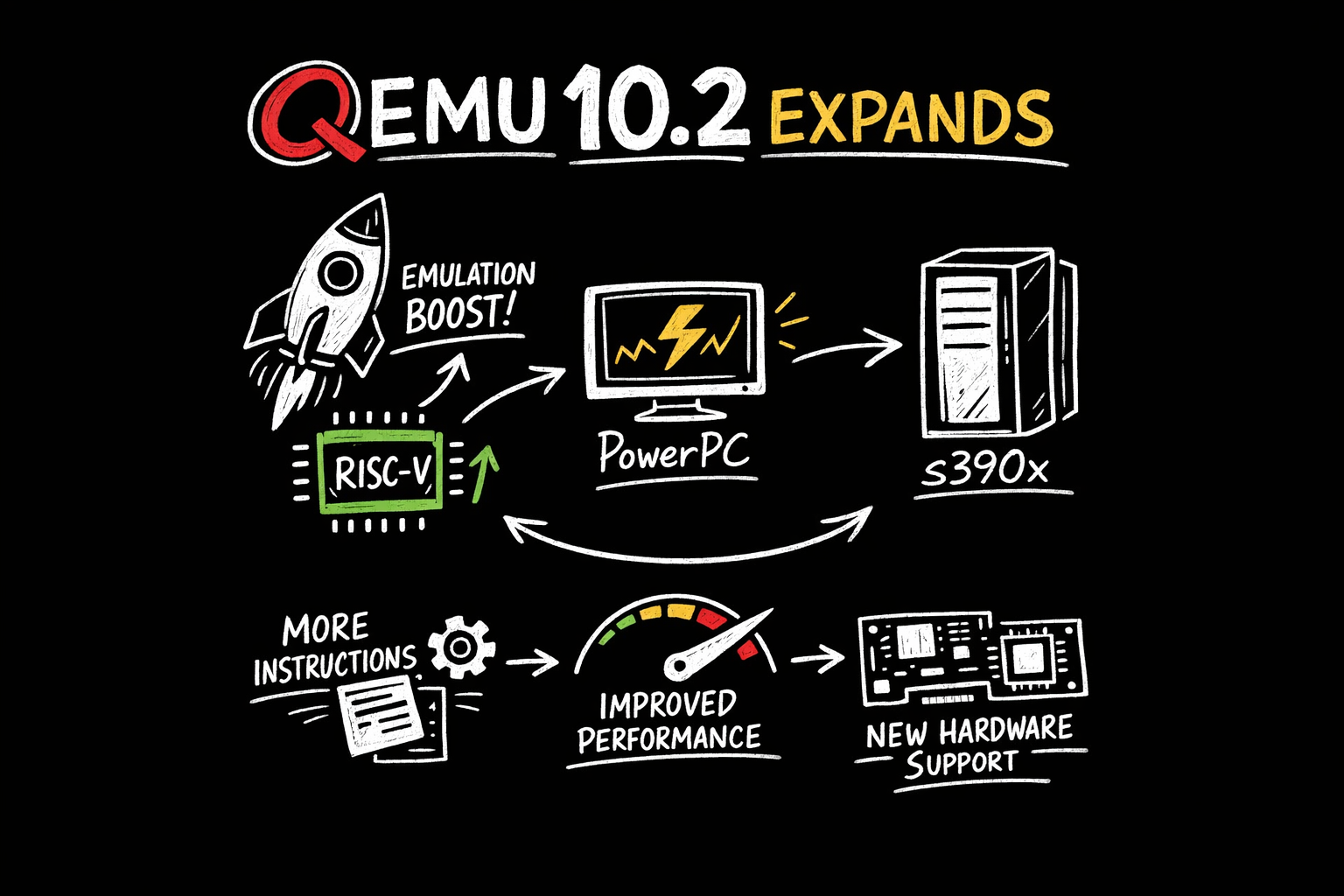
But if you rely on QEMU for RISC-V, PowerPC, or s390x emulation, this release quietly removes long-standing friction, improves correctness, and lays important groundwork for future performance and security work.
It’s the kind of update that doesn’t demand attention—but makes your systems behave better over time.
Not Just “Another Update”: What Changed at a High Level
QEMU 10.2 is the second point release in the 10.x series, following four release candidates. Instead of introducing radical new concepts, the focus is clearly on stability and refinement:
- Cleaning up legacy behavior
- Improving correctness across architectures
- Preparing QEMU for future security and scalability demands
Once you look past the raw changelog, a consistent theme emerges: less technical debt, fewer surprises.
See also: Mastering the Linux Command Line — Your Complete Free Training Guide
Drawing a Clearer Line on Security
One subtle but important change in QEMU 10.2 is a clarification of the project’s security policy.
QEMU now explicitly defines which machine types fall under the “virtualization use case” when determining whether an issue qualifies as a security bug.
This matters because QEMU serves two very different audiences:
- Virtualization users running real workloads
- Emulation users modeling hardware behavior
By drawing a clearer boundary, QEMU improves predictability in vulnerability handling—especially for users running QEMU in production or security-sensitive environments.
Letting Go of Legacy Baggage
QEMU 10.2 continues a long-running cleanup effort by removing components that have been deprecated for years:
- The long-deprecated
old-paramoption is gone - The Arm PXA CPU family has been fully removed
- Unusable legacy CPUs are dropped across multiple architectures
These removals don’t break modern setups—but they reduce maintenance cost and make QEMU easier to evolve safely.
Architecture Updates: Small Changes, Real Benefits
Arm: Expanding Capabilities, Better Debugging
Arm emulation gains several new CPU features, including SCTLR2, TCR2, LSE128, and RME-related extensions. Debugging also improves, with the gdbstub now exposing SME and SME2 registers.
For developers working close to the hardware, these changes make modern Arm systems easier to inspect and reason about.
RISC-V: Fewer Edge Cases, More Confidence
RISC-V continues to mature inside QEMU, with a strong focus on correctness:
- Fixes to control-flow integrity
- Configurable PMP granularity
- Updated OpenSBI firmware
- Multiple fixes affecting timers, MMU handling, and instruction behavior
Individually modest, these fixes add up to a more predictable and trustworthy RISC-V environment.
PowerPC and s390x: Steady Progress for Enterprise Platforms
PowerPC emulation adds support for newer PowerNV and PPE machines, introduces FADUMP support on pSeries, and updates firmware components. Similar incremental improvements land across s390x, along with updates for LoongArch, HPPA, and other architectures.
The emphasis is clear: maintain fidelity, reduce legacy noise, and keep enterprise platforms healthy.
Platform and Device Emulation Improvements
Platform support expands with:
- A new
amd-versal2-virtboard - Improved modeling for Xilinx ZynqMP systems
- Added PCIe and secure-boot related devices for several ASPEED SoCs
On the device side:
- RPMB support is added to the eMMC model
- Deprecated VFIO platform devices are removed
- Improvements land across PCIe, storage, networking, and virtio subsystems
FreeBSD hosts benefit from extended support in areas like 9pfs, while user-mode emulation gains new syscalls, better signal handling, and architecture-specific fixes.
Security, Cryptography, and What Comes Next
QEMU 10.2 raises the minimum supported versions for GNUTLS, libgcrypt, and nettle, tightening the cryptographic baseline.
More notably, QEMU can now load multiple X.509 certificate identities, a prerequisite for future transitions toward post-quantum cryptography. TLS handling also improves with fixes for potential use-after-free issues and more accurate certificate validation.
This isn’t about chasing trends—it’s about ensuring QEMU remains viable as security expectations evolve.
Migration, Performance, and Future Scalability
Migration-related fixes address regressions in postcopy migration, snapshots, and VFIO performance after migration.
On supported hosts, QEMU’s main loop can now use io_uring. While this doesn’t radically change performance today, it lays the groundwork for better scalability and lower overhead in future releases.
Developer-Facing Updates
For developers building on QEMU:
- Tracing code generation is optimized, reducing binary size
- New TCG plugin hooks are available
- The minimum supported Rust version is now 1.83
Rust support remains experimental and development-focused, but feature parity for Rust-backed devices continues to improve.
Reference : https://wiki.qemu.org/ChangeLog/10.2