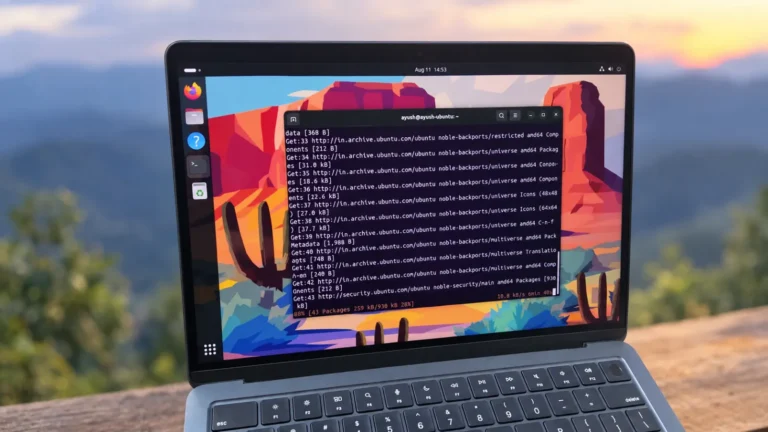

“Last week was nice and calm… so I’ve tagged and pushed out 6.16 as planned.”
That’s how Linus Torvalds casually announced the release of Linux kernel 6.16 — no drama, no last-minute bugs, no frantic race to fix regressions.
But while the release was calm on the surface, the patch notes tell a different story: this kernel quietly introduces some big improvements.
If you haven’t been keeping up, don’t worry — here’s a clear breakdown of what changed in Linux 6.16, why it matters, and what to expect next.
Table of Contents
1. XFS Gets Large Atomic Writes — and That’s a Big Deal
If your workloads depend on XFS, this one’s worth pausing for.
Linux 6.16 introduces support for large atomic writes, which means multi-block write operations will now either fully succeed or fully fail — no more torn writes.
That’s big news for reliability in large-scale data systems and databases. Before this, partial failures could leave things in an inconsistent state. Now? Not so much.
2. Ext4 Just Got Way Faster for Some Workloads
Ext4 isn’t going away anytime soon — and this release gives it a serious performance tune-up:
- Improved fast commit path
- Support for multi-fsblock atomic writes on
bigallocsystems - Large folio support
All of this adds up to up to 37% faster sequential I/O in real-world workloads.
See also: Mastering the Linux Command Line — Your Complete Free Training Guide
If your server or laptop still uses Ext4 (and many do), you’ll probably feel the difference — especially for large file transfers or database ops.
3. USB Audio Offload Means Better Battery Life
After years in development, Linux finally gets USB audio offload.
What does that mean? Simple: your CPU can go to sleep while the audio keeps playing.
Embedded devices and laptops — especially those running on battery — can now save power by letting the USB controller handle audio streams directly.
If you’re running a lightweight Linux distro on a laptop, this is one of those silent improvements you’ll appreciate every day.
4. Intel TDX Is Here — Secure Virtual Machines Get a Boost
Security-minded folks, take note: Linux 6.16 brings initial support for Intel TDX (Trusted Domain Extensions).
In short, TDX offers hardware-encrypted memory for virtual machines, shielding them from the host — even if the host gets compromised.
It’s a big step for confidential computing, putting Intel on similar footing with AMD’s SEV-SNP. Expect cloud platforms to start leaning on this soon.
5. Zero-Copy TCP for GPU Buffers? Yep.
Linux has been quietly leveling up its zero-copy game.
After adding zero-copy TCP receive paths in 6.12, kernel 6.16 now supports zero-copy TCP sends from DMABUF memory — great for workloads that pass data between GPUs, NICs, or other accelerators.
The result? Less CPU usage and faster networking in high-performance, data-heavy environments.
6. Memory Allocation on NUMA Machines
On modern systems with Non-Uniform Memory Access (NUMA), not all memory is equal — some nodes are faster than others.
Linux 6.16 introduces automatic weighted interleaved memory allocation, meaning it can dynamically prefer faster memory nodes based on bandwidth data.
7. Intel APX Support — More Registers, More Performance
Say hello to Intel APX (Advanced Performance Extensions).
This new CPU feature doubles the number of general-purpose registers (from 16 to 32), allowing for more efficient code execution.
Linux 6.16 adds support for this architecture — setting the stage for performance and power gains on future Intel chips.
8. Native-Optimized Kernel Builds
Love compiling your own kernel? There’s a new toy for you.
With the new CONFIG_X86_NATIVE_CPU flag, you can now enable -march=native by default. That means your kernel will be auto-optimized for your exact CPU without tweaking makeflags manually.
It’s a small thing — but it makes DIY builds easier and faster.
Other Quiet but Cool Stuff
Not all upgrades got the spotlight, but here are a few worth noting:
- Futex2: Now supports NUMA-aware operations and process-local hashing — better multithreaded performance.
- AF_UNIX coredumps: More secure and predictable crash handling via Unix domain sockets.
- Btrfs & NFS improvements: More efficient metadata writeback and new attribute support.
- Rust in the kernel: More subsystems (like
clk,cpumask, andmmap) now have Rust abstractions — meaning the Rust-powered kernel is growing steadily.
Oh, and About Linux 6.17…
Linus left a little note about the upcoming 6.17 merge window:
“It’s going to be slightly chaotic for me — family events, weddings, travel… I’ll try to get as many PRs handled early, but it might run a bit late.”
Final Thoughts
Linux 6.16 isn’t a flashy release — but it’s a solid one.
From faster filesystems and smarter memory allocation, to zero-copy TCP and hardware-level VM protection, this kernel quietly raises the bar across the board.
You can grab the source at kernel.org today. And if you’re on a rolling-release distro? Sit tight — the update’s probably already on its way.