Feel like there is a groundbreaking AI announcement every other week? I get it. The fatigue is real. It’s hard to distinguish the hype from the tools that will actually change how we work.
But if you only pay attention to one release this season, make it this one.
Anthropic just released Claude Sonnet 4.5 (as of late September 2025). If you look at the raw numbers, they are absurdly good. It’s crushing benchmarks left and right.
However, the benchmarks aren’t the real story here. The real story is stamina.
Imagine hiring a brilliant intern who forgets everything you said after 30 minutes. That’s been the reality of most AI models until now. Sonnet 4.5 changes the game. It can maintain focus on complex, multi-step projects for over 30 hours.
We are moving from “chatting” with AI to “collaborating” with AI agents. Ready to see what that actually looks like? Let’s break it down.
Table of Contents
The Headline: The New King of Coding (and Focus)
Let’s get the nerdy stuff out of the way first.
On SWE-bench Verified—a test that mimics real-world software engineering problems—Sonnet 4.5 scored 77.2%. For context, that is the highest score ever achieved, and it isn’t particularly close.
But here is why this matters to you, even if you aren’t a software engineer.
That score means the model understands context. It doesn’t just solve a quick riddle; it navigates a complex environment.
See also: Mastering the Linux Command Line — Your Complete Free Training Guide
Here is where Sonnet 4.5 is excelling right now:
- Computer Use: It’s getting much better at navigating operating systems like a human does.
- Agentic Tasks: This is the “30-hour focus.” It can handle long-running projects without “losing the plot.”
- Math and Reasoning: Substantial gains across the board.
And the best news? The pricing is exactly the same as the previous Sonnet. You are getting dramatically better performance for no extra cost.
More Than Just a Model: The New Toolkit
Anthropic understands that a smart brain needs good hands to do the work. They didn’t just ship a model; they shipped an entire ecosystem upgrade.
This is where things get exciting for daily users.
1. Claude Code is Finally Safe to Use
If you’ve used AI for coding, you know the pain of an AI hallucinating and overwriting your good work.
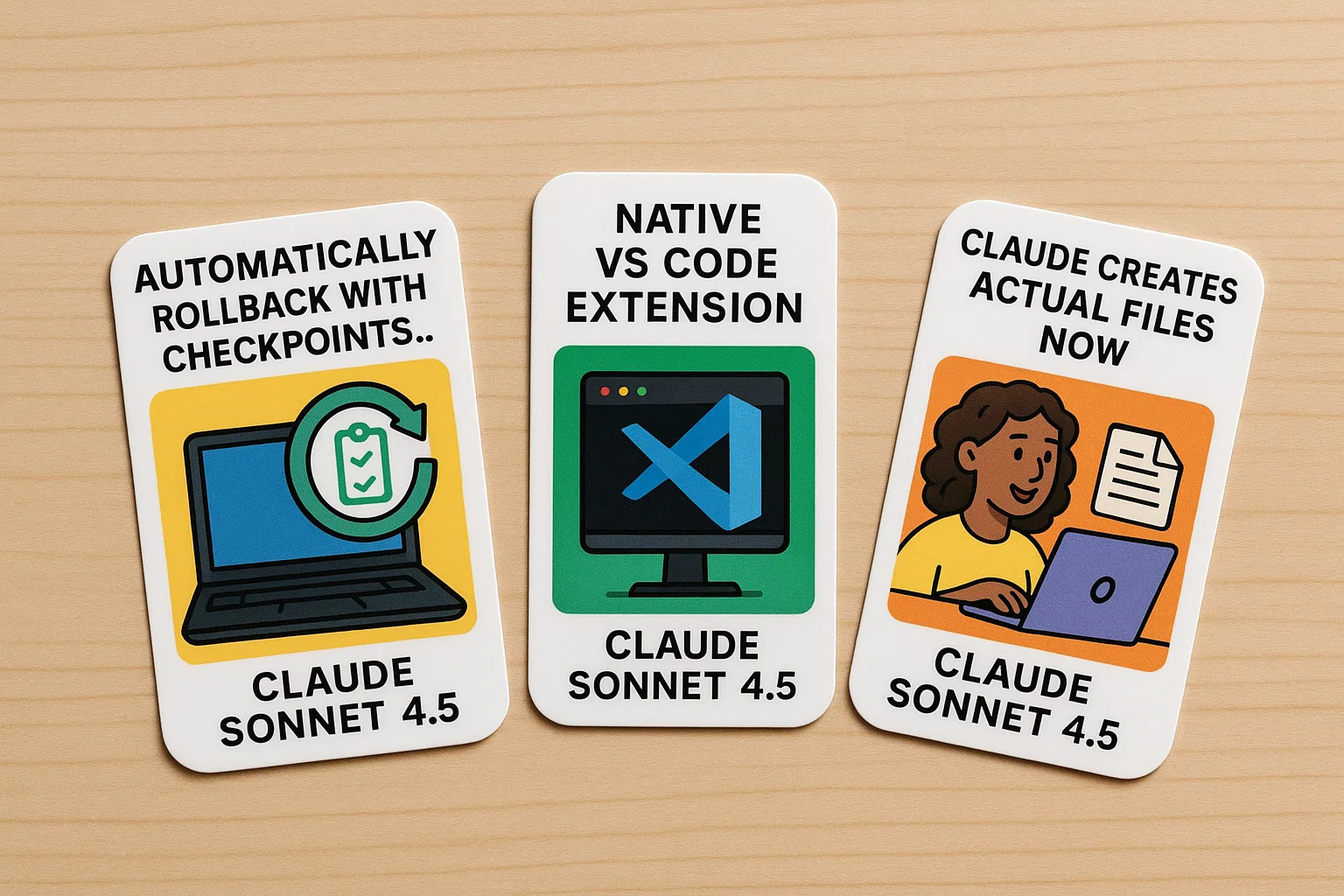
Anthropic has introduced Checkpoints. Think of this like a “save game” feature. Claude now automatically saves your state before changes.
If it messes up, you can instantly roll back. This gives you the confidence to let Claude attempt big, ambitious changes knowing you have a safety net.
2. It Lives Where You Work
No more copy-pasting between your browser and your code editor. There is now a Native VS Code Extension. Claude lives in your sidebar and shows you changes in real-time.
3. Claude Creates Actual Files Now
This is my personal favorite update for non-technical users.
Previously, if you asked for a spreadsheet, Claude would give you a text-based table and say, “Here, paste this into Excel.”
Now? Claude Sonnet 4.5 can create and edit actual .xlsx (Excel), Word docs, PowerPoints, and PDFs directly in the app. You give it raw data, ask for an analysis, and it gives you a polished, working spreadsheet file with formulas included.
Why this is huge: It bridges the gap between getting advice and getting a finished product.
For the Builders: The Agent SDK
If you are a developer looking to build your own AI tools, listen up.
Anthropic is open-sourcing the infrastructure that powers their own Claude Code. It’s called the Claude Agent SDK.
Before, building an “agent” (an AI that can take multiple steps to solve a problem) meant solving headaches like memory management and permissions yourself. Now, Anthropic is handing you their solutions.
Developers are already using this to build specialized agents for finance, cybersecurity, and deep research. The SDK handles the boring infrastructure so you can focus on solving the problem.
The Vibe Check: What Are People Saying?
Benchmarks are one thing; calling it “The World’s Best” is marketing. What is the reality on the ground?
The consensus among early testers and builders is very positive, but nuanced.
- The Feel: It feels noticeably faster and smarter than the previous powerhouse, Claude Opus.
- The Sweet Spot: It seems to be seeing the biggest jumps in areas like finance, statistics, and data dashboards.
- The Reality Check: It’s not perfect. Some developers still prefer GPT-5 Codex for very specific, gnarly code reviews. We live in a multi-model world, and that’s okay.
- The Competition: While Anthropic claims the crown, the landscape shifts fast. Other models like GPT-5 High and the rumored Gemini 3 are right there with it.
My take: For 90% of users, the combination of Sonnet 4.5’s intelligence, its new file-creation tools, and its current pricing makes it the best daily driver available right now.
Your Guide to Prompting Sonnet 4.5
Don’t worry, using it is a straightforward process. But because its “personality” has shifted, you should adjust how you talk to it to get the best results.
Here is what we learned from its system prompt:
1. Cut the Small Talk
The model is instructed to be direct. It’s told not to start responses with flattery like, “That is a fascinating question!” Your move: Be direct right back. You don’t need to be polite. Focus on efficiency and clarity in your requests.
2. It is Not a “Yes-Man”
Sonnet 4.5 is instructed to “critically evaluate” your ideas. If you propose a flawed theory, it is trained to respectfully point out the errors rather than just validating you. This is a significant improvement in reducing “sycophancy.” Your move: Use this to your advantage. Treat Claude as a critical thinking partner. Ask it to poke holes in your plans.
3. Specify Your Format
By default, it prefers paragraphs over bullet points for explanations. Your move: If you want a list, a table, or a specific code block, ask for it explicitly. Don’t fight its defaults; just give clear instructions.
4. Trust It with Current Events
The training data cuts off in January 2025. However, it is instructed to use web search automatically without asking permission if you ask about current events. Your move: Just ask your question. You don’t need to add “please search the web for this.” It knows when it needs fresh data.
Final Thoughts
We are entering a new phase of AI. The novelty of a chatbot that can write a funny poem is gone. We are now looking for reliable, autonomous tools that can do actual work.
Claude Sonnet 4.5, with its incredible focus and improved tooling, is perhaps the biggest step we’ve seen in that direction yet.
Give it a try on a real project—something that would usually take you all day. You might be surprised by how much it can handle.