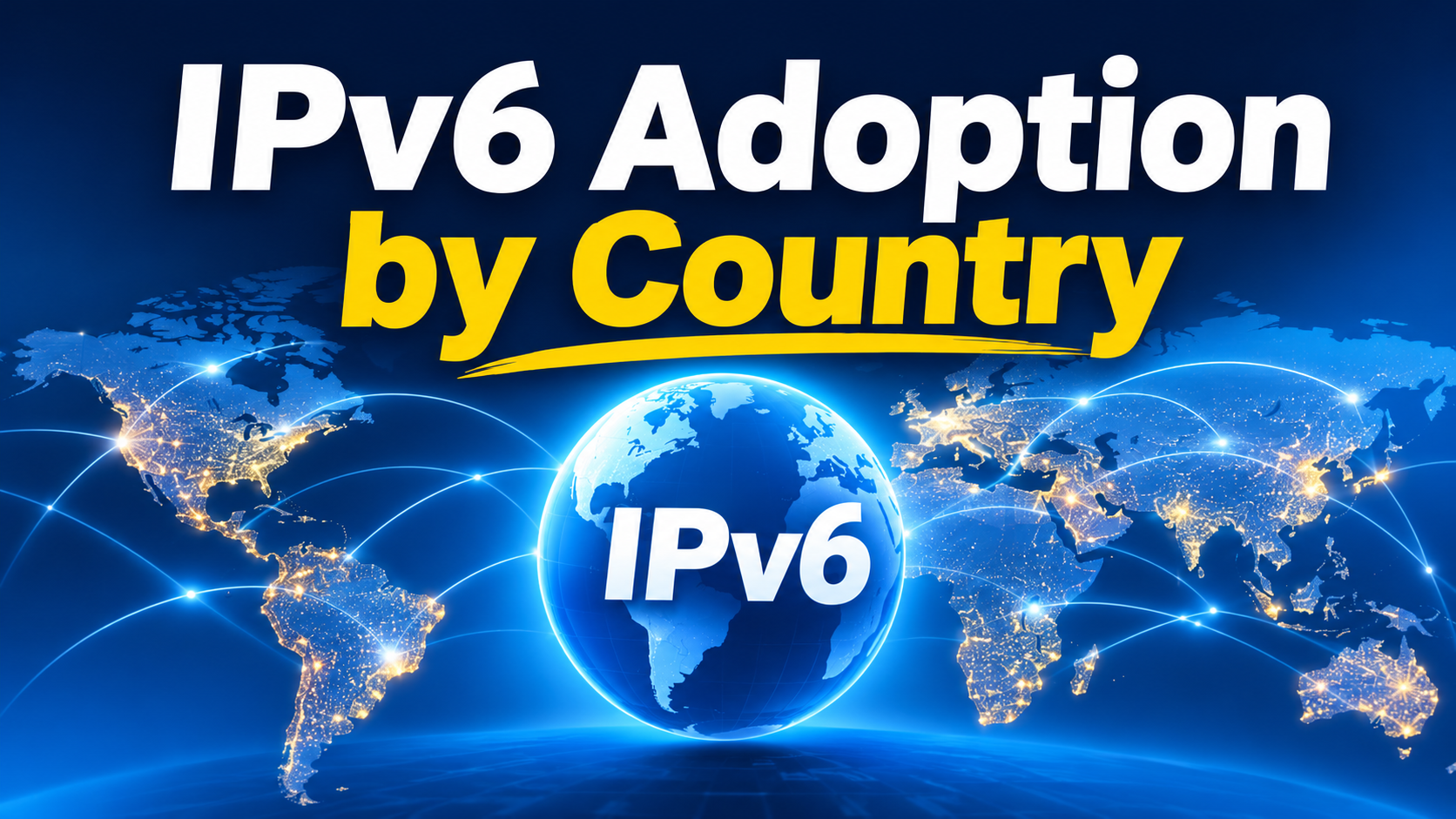
Every device on the internet needs an address, just like every house needs a street address so the mail can find it. The problem? We ran out of the old kind of addresses years ago. IPv6 is the fix, and in 2026 about half of the world is using it. But depending on where you live, your experience could be very different.
Table of Contents
IPv4 vs IPv6, in Plain English
The internet has used IPv4 addresses since the early 1980s. An IPv4 address looks like 203.0.113.42. There are only about 4.3 billion of them, which sounded like plenty in 1981. Today there are more phones than people, plus laptops, TVs, cameras, cars and smart light bulbs. The numbers simply don’t add up.
IPv6 is the newer system. Its addresses are longer, for example 2001:db8::1, and there are about 340 undecillion of them (a 34 followed by 37 zeros). That is enough to give every grain of sand on Earth its own address many times over. We will not run out.
Think of it like phone numbers. When a city runs out of 7-digit phone numbers, it adds more digits. IPv6 does the same thing for the internet, just on a much bigger scale.
So why isn’t everyone on IPv6 already? Because the two systems don’t speak directly to each other. Every internet provider, website, router and device has to be upgraded to support both. That takes time and money, and it happens at very different speeds around the world.
Which Countries Lead IPv6 Adoption?
The chart below shows the share of internet users who connect over IPv6 in a handful of countries. The gap is huge: in France and India, roughly 7 out of 10 users are on IPv6. In Egypt, it is fewer than 1 in 20.
Source: Internet Society Pulse, April 2026. Dark blue = 50% or more.
What makes the leaders different? In most cases it comes down to a few big mobile and broadband providers switching IPv6 on by default.
- India jumped ahead largely because Reliance Jio launched its mobile network with IPv6 built in from day one. With hundreds of millions of subscribers, one company moved the whole country.
- France benefits from major ISPs such as Free and Orange enabling IPv6 for home and mobile customers.
- Countries at the bottom usually still have enough IPv4 addresses, or rely on workarounds that let many customers share one IPv4 address, so there is less pressure to upgrade.
How Fast Is IPv6 Growing Worldwide?
Google publishes the share of its users who reach Google over IPv6 every single day. It is one of the best long-term views we have. Averaged per year, the growth has been slow but remarkably steady:
Source: Google IPv6 Statistics, yearly average of daily values, 2015–2025.
In 2015, fewer than 7% of users came over IPv6. By 2025 it was close to 46%. That is roughly 4 percentage points a year, every year, for a decade. On some days in 2026, Google’s daily figure has even passed 50%.
Fun fact: IPv6 numbers are usually higher at weekends. People are at home on their phones and home Wi-Fi, which tend to support IPv6, instead of on office networks, which are often still IPv4-only.
A Second Opinion: Cloudflare’s View
Cloudflare, which sits in front of a large share of the world’s websites, measures things a little differently. It looks at requests from devices that can use both IPv4 and IPv6, and checks how many actually used IPv6.
Source: Cloudflare Radar Year in Review, 2025.
Why is this lower than Google’s ~47%? Different companies measure different things. Google counts users, while Cloudflare counts requests, which include a lot of traffic from servers, bots and business networks that often still run on IPv4. Neither number is “wrong”. Together they tell us that home and mobile users are moving faster than the rest of the internet.
Country Comparison at a Glance
| Country | IPv6 adoption | What it means |
|---|---|---|
| France | 73% | Most users are already on IPv6 |
| India | 72% | Driven by mobile networks |
| Saudi Arabia | 65% | Strong push from major operators |
| Italy | 17% | Still mostly IPv4 |
| Spain | 10% | Early stage of the switch |
| Egypt | 4% | Very little IPv6 traffic so far |
Source: Internet Society Pulse, April 2026.
Why Should You Care?
- For everyday users: probably nothing changes. Your phone and router handle IPv6 automatically, and websites work the same either way.
- For website owners: make sure your site is reachable over IPv6. Most CDNs and modern hosts enable it with one click. Otherwise, IPv6-only users may get a slower, translated connection.
- For businesses: IPv4 addresses are now bought and rented like property, and prices have climbed. Moving to IPv6 avoids that cost over the long run.
How to Check If You Are Using IPv6
The easiest way is to visit a test site such as test-ipv6.com. It will tell you in a few seconds whether your connection supports IPv6. If you are comfortable with a terminal, run:
curl -6 https://ifconfig.co
If you see a long address with colons in it, congratulations: you are on IPv6.
FAQ
Is IPv6 faster than IPv4?
Not by itself. In practice IPv6 can feel slightly faster on some networks because it avoids the address-sharing tricks used with IPv4, but for most people the difference is too small to notice.
Will IPv4 stop working?
Not any time soon. Most networks run both side by side (called “dual-stack”). IPv4 will likely stay around for many years while IPv6 slowly becomes the default.
Is IPv6 more secure?
IPv6 was designed with modern security features in mind, but in real life security depends on how a network is configured. A well-managed IPv4 network can be just as safe.
Why do different sources show different IPv6 numbers?
Each source measures a different slice of the internet. Google measures users visiting Google, Cloudflare measures requests to the sites it protects, and the Internet Society combines several data sets. Look at the trend, not one exact number.
The Bottom Line
IPv6 is no longer “the future”. It is already here for about half of internet users. The switch is happening country by country, and usually one big network at a time. If the steady growth of the past decade continues, IPv6 will be the majority choice worldwide within the next few years.