
AI tools weaponized a critical PHP flaw in hours. Governments shut down websites. But before catastrophe struck, one unpaid maintainer was standing between millions of servers and total collapse.
If you visited the web earlier this week, you probably didn’t realize how close the entire house of cards came to tumbling down.
On October 21, 2026, two critical remote code execution flaws — dubbed PHP2Shell and carrying devastating CVSS scores of 9.2 — were prematurely exposed to the world. PHP powers nearly 70% of all websites on the internet, from government portals and universities to e-commerce engines and WordPress blogs.
Within minutes of the leak, the global network lit up like a Christmas tree. Cloudflare clocked hundreds of thousands of live exploit attempts per hour. Government departments in Germany, France, and Belgium preemptively pulled public websites offline. Cybersecurity experts publicly urged people to consider worst-case scenarios.
Yet when millions of servers woke up the next morning safely patched, the salvation didn’t come from a multinational cloud conglomerate or a billion-dollar cybersecurity firm.
It came from a quiet volunteer living in the Czech Republic who maintains the world’s most widely used Debian and Ubuntu PHP packages in his spare time.
His name is Ondřej Surý.
By the time you finish this short read, you will understand how modern AI broke the unwritten rules of vulnerability disclosure, why the fragile foundation of the modern internet still rests on a handful of unpaid heroes, and what this near-miss means for the future of digital security.
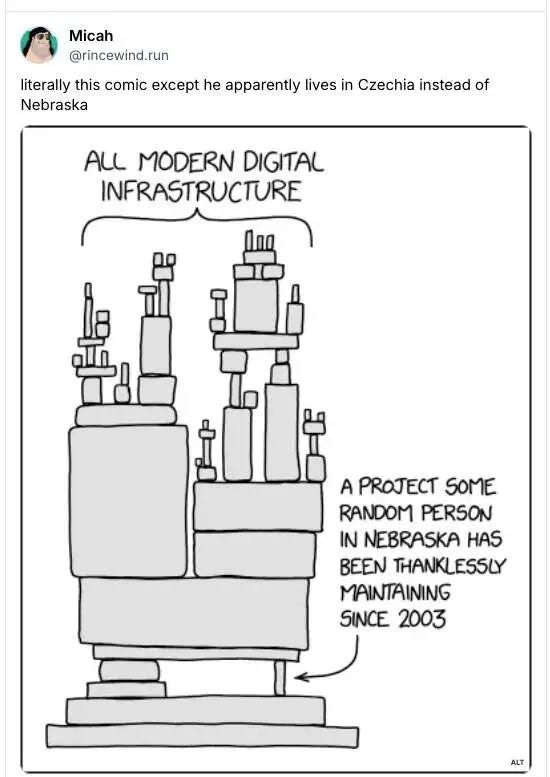
Table of Contents
The Anatomy of an Accelerated Nightmare
To understand how the panic ignited, you have to look at the fragile dance of vulnerability coordination.
Usually, security researchers follow a gentleman’s agreement: find a bug, report it quietly to upstream developers, give them weeks or months to build and test a patch, and announce it on a calm Thursday morning.
See also: Mastering the Linux Command Line — Your Complete Free Training Guide
This time, the timeline exploded.
Researchers at Wiz, Calif, and OpenAI had utilized AI tools to unearth severe memory-corruption vulnerabilities in PHP’s C core. Meanwhile, security firm Chainguard revealed that their own AI harness, guided by a prompt as barebones as “find critical vulnerabilities in PHP,” had independently flagged the exact same flaws.
The PHP Foundation had been laboring over patches for months. They had originally scheduled the emergency fix for Thursday.
Then came the leak: an unverified proof-of-concept video surfaced online on Tuesday. Rumors began tearing through hacker forums. Cloudflare’s CEO Matthew Prince reported that before the flaw was even officially detailed, attacks were already multiplying exponentially across their edge network — jumping from thousands of probes to millions in less than two hours.
The PHP team had no choice. They scrambled their clocks and pushed the public release forward to Wednesday.
That single decision squeezed global system administrators by twenty-four hours. And it dropped an unimaginable burden right onto the lap of a single volunteer.
The Man Behind the Machine
If you manage a Linux server running Ubuntu or Debian, you have almost certainly typed add-apt-repository ppa:ondrej/php.
Yet hardly anyone outside of core Linux circles knew who the person behind that repository was.
Software developer Ian Landsman captured the surreal reality on X:
“I explained to my wife that there is one guy who maintains virtually the entire PHP distribution packaging for the world. If anything happens to this guy, it’s over. Everyone is screwed.”
Ondřej Surý doesn’t work for Google, and he isn’t salaried by the PHP Foundation. His day job is Director of DNS Engineering at the Internet Systems Consortium (ISC). Packaging PHP for Debian and Ubuntu has been his hobby and volunteer commitment for more than twenty years.
The official PHP project publishes source code. But the overwhelming majority of the world’s web hosts, cloud users, and small businesses cannot compile a complex C codebase from source in the middle of a cyber emergency. They need pre-built, cryptographically signed binary packages that install with a single apt upgrade.
Without Surý, millions of web operators would have been forced to manually patch and recompile their engines by hand while exploit bots were hammering their open ports.
“If I Got Hit by a Bus, It Would Be Someone Else’s Problem”
In an extraordinary interview with The Atlantic’s Charlie Warzel, Surý described the 48-hour whirlwind with the kind of calm pragmatism only a veteran systems engineer can muster.
While social media was melting down, Surý sat at his desk, methodically compiling, testing, and shipping pre-packaged binaries for Debian and Ubuntu users worldwide.
When Warzel asked him why he wasn’t panicking, Surý offered a delightfully candid perspective:
“First, I’ve been doing this for more than 20 years. Much of what I do is automated. And another reason: I don’t actually run any systems with PHP myself… If I got hit by a bus, it would become someone else’s problem.”
He added that he was lucky he wasn’t vacationing on a sailboat in the Adriatic Sea when the alert came through. Because the PHP project trusted him enough to bring him into the private coordination loop early, he had his automation pipelines primed and ready the instant the embargo broke.
In the twenty-four hours that followed, grateful sysadmins flooded his donation links. Surý noted that the contributions poured in at a historic clip — matching in a single day what he usually collects over an entire year.
The Dark Reality of the “Bus Factor”
It is tempting to read Ondřej Surý’s story as a feel-good superhero tale. A humble engineer steps up, writes some scripts, and rescues the digital world in the nick of time.
The reality, as Surý himself pointed out, is deeply uncomfortable.
The modern internet is a trillion-dollar economic engine built on top of unpaid volunteer labor. Trillion-dollar corporations generate billions in profit using open-source tools maintained by people surviving on modest Patreon donations.
The PHP Foundation later acknowledged that one of the underlying bugs had actually surfaced during an external security audit as far back as 2024. But due to limited engineering resources and a shortage of developers who deeply comprehend the engine’s labyrinthine internals, a definitive fix took nearly two years to materialize. They called this what it is: a “structural failure.”
Cryptographer Matthew Green captured the eerie mood of this new era best:
“We are at the point in the movie where we’re throwing whatever we can find in front of the zombies just to slow them down… The internet is a pile of dried kindling, and the only reason it hasn’t burned is because the teenagers haven’t found the matches yet.”
What Comes Next in the AI Era
This crisis marked an unmistakable turning point: AI has permanently compressed the timeline between bug discovery and weaponization.
When an LLM can scan millions of lines of legacy C code in seconds, the defensive playbook has to evolve. Security through obscurity is dead. Long, leisurely embargo periods are vanishing.
If there is any comfort to take from this week’s 48-hour scramble, it is that human ingenuity and goodwill still hold the line. When the alarm sounded, the community rallied, the patches shipped, and the internet stayed online.
Surý’s parting advice to everyday users caught in this fast-moving storm was simple: trust the experts. Keep your operating systems updated, support the maintainers whose code you rely on, and never take the invisible plumbing of the web for granted.
Because the next time a critical zero-day drops, our savior might just be on that sailboat.